Breach Deadline Clock
Track the notification deadline on a data breach, one state at a time
The video below shows Breach Deadline Clock running on a real Odoo 19 database. Want it driven against your own data, or a question answered first? Ask and we will set up a session.
A data breach starts a clock, and the clock is the part people lose track of while they are busy handling the breach itself.
This keeps it. Record the incident, the date it was discovered, the state whose residents are affected and the notification period that applies, and the deadline and days remaining are worked out for you.
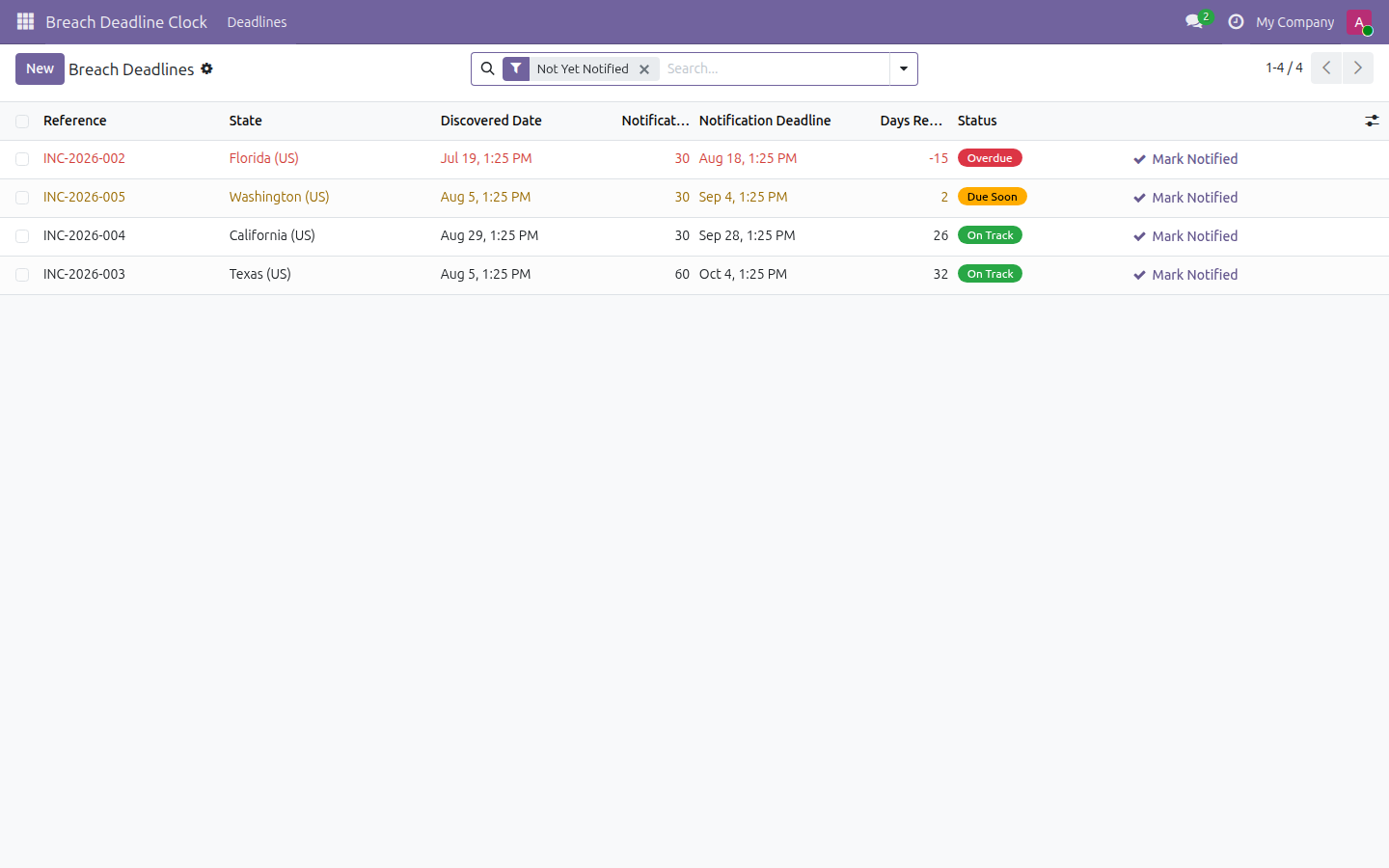
On track, due soon, overdue and notified - at a glance, with days remaining on each.
What it does
The notification period is yours to enter
This app ships no legal data. State notification periods are statute, they differ, and they change - an app that asserts them for free, without citing a source or a verification date, is a liability rather than a convenience. You enter the period your counsel relies on and record where it came from; a test in the module asserts no reference data is shipped.
Where this stops being enough
One incident, one state. A breach affecting residents of more than one state needs the deadlines fanned out and the earliest one surfaced - that is a different job, and it is what the paid app does.
Not tax advice
This app performs date arithmetic on figures you supply, and ships behind its own access group rather than being visible to every employee. It is not legal advice and it does not determine your obligations - confirm those with counsel.
What it does not do
Stated up front so nothing about the scope is a surprise after you install it.
Screenshots
Requirements
- Odoo 19.0, Community or Enterprise.
- Odoo.sh or On-Premise only. Third-party apps cannot be installed on Odoo Online (SaaS) databases — check your hosting before buying.
- Module
mh_breach_deadline_clock, version 19.0.1.0.9, licensed OPL-1.
Related apps
Eleven access tools in one app, from who-can-do-what across every model to safe offboarding
See exactly what every user can read, write, create and delete across every model, resolved through group inheritance and record rules
Set the default list view columns for a model and assign them per group, so a team opens the same layout instead of rebuilding it