GDPR 72-Hour Clock
The Article 33 clock, holding none of the breach detail
The video below shows GDPR 72-Hour Clock running on a real Odoo 19 database. Want it driven against your own data, or a question answered first? Ask and we will set up a session.
GDPR Article 33 gives you 72 hours from becoming aware of a personal data breach to notify the supervisory authority. Three days is not long, and the hours are easy to lose while everyone is busy dealing with the breach itself.
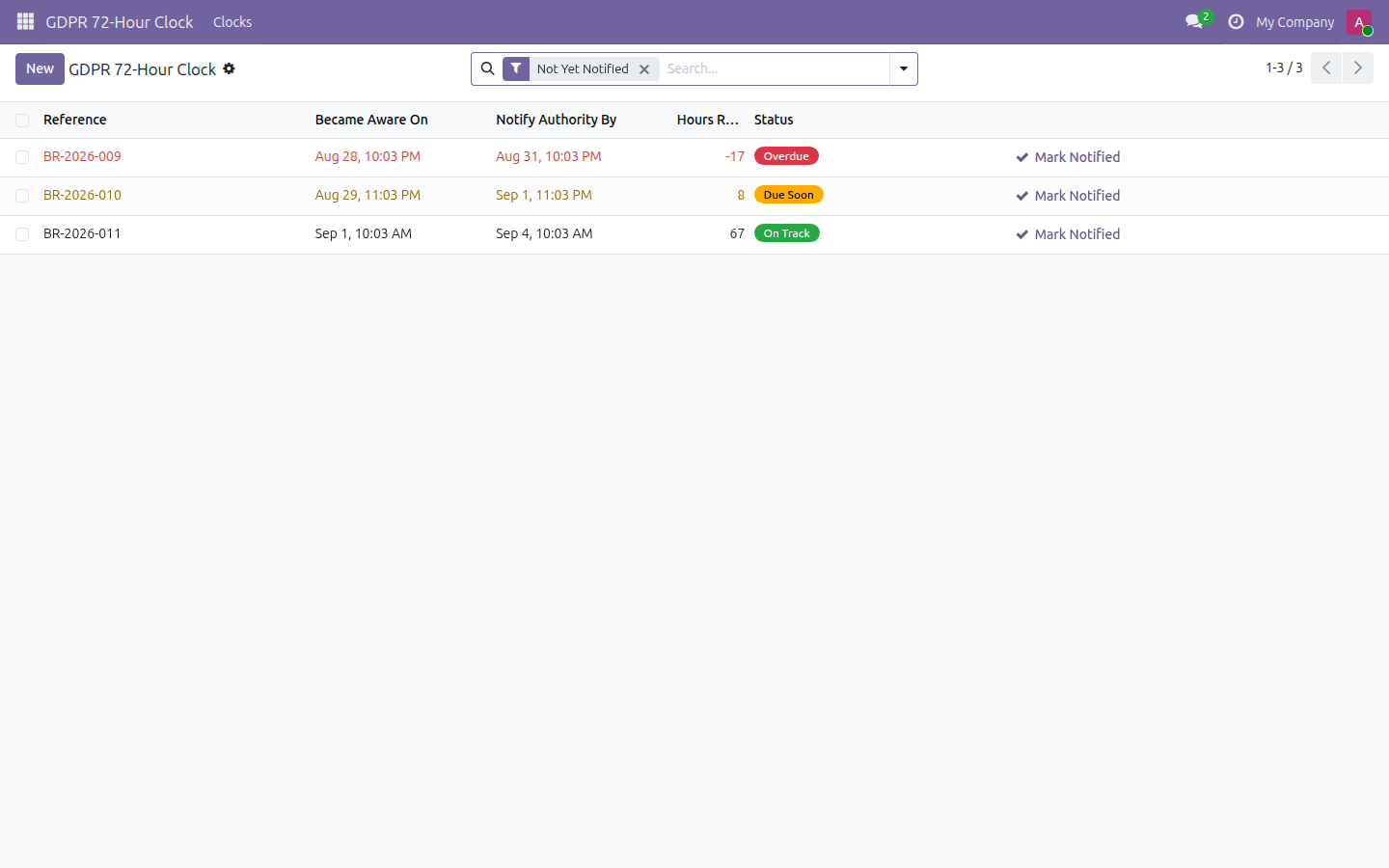
This runs the clock. Record your own reference and the moment you became aware, and the deadline, the hours remaining and whether you are overdue are all worked out for you.
Hours remaining on every open incident, with overdue and due-soon called out.
What it does
Holds none of the breach, on purpose
There is no field here for what happened, the risk, the categories of data, the people affected, the consequences or the measures taken - and that is not an omission to upsell you. An Article 33 record needs all of those and the confidentiality to match; a clock needs none of them to run. A test in the module asserts no such field can be added later.
72 hours, from awareness
The clock runs from the moment the controller became aware, not from when the breach happened or when it was contained. That is the date Article 33 turns on, and it is the only date this app asks you for.
Not tax advice
This app counts hours from a time you enter, and ships behind its own access group rather than being visible to every employee. It is not legal advice, and whether a breach is notifiable at all is a judgement for you and your adviser.
What it does not do
Stated up front so nothing about the scope is a surprise after you install it.
Screenshots
Requirements
- Odoo 19.0, Community or Enterprise.
- Odoo.sh or On-Premise only. Third-party apps cannot be installed on Odoo Online (SaaS) databases — check your hosting before buying.
- Module
mh_gdpr_72h_clock, version 19.0.1.0.9, licensed OPL-1.
Related apps
Eleven access tools in one app, from who-can-do-what across every model to safe offboarding
See exactly what every user can read, write, create and delete across every model, resolved through group inheritance and record rules
Set the default list view columns for a model and assign them per group, so a team opens the same layout instead of rebuilding it